

Steel coils: origin and specification before price per tonne
Coil analysis requires mill traceability, trade-remedy scope checks and unloading arrangements.
Strategic analysis by Jiuann Teng — editorial baseline: 10/31/2026. This is neither news nor confirmation of a regulatory change on this date. The decisions below depend on the specific product, intended purpose, and actual operation. Reconfirm applicable regulatory text prior to contracting and prior to shipment.

Equal tonnage can deliver different results
Define contractual technical standards, grade, thickness and tolerance, width, coating, finish, and coil weight. The choice must stem from the industrial application: stamping, roll forming, or other processing. A lower price loses its relevance when the material requires rework or fails to meet the expected yield. Tie the mill test certificate and heat or lot identification directly to the units actually dispatched.
Request manufacturer identification and proof of origin. Country of shipment, seller's country, and country of origin are not interchangeable concepts. Transacting through a trading company does not, in itself, alter the origin of the goods. Include in the contract an obligation to disclose any change of mill and prohibit unapproved substitutions. Technical documentation must substantiate the tariff classification; do not select a description merely to secure more favorable taxation.
On the shop floor, improper specifications create severe bottlenecks. The most frequent mistake is ordering steel under generic commercial designations without establishing parameters for yield strength, tensile strength, and elongation. When thickness tolerances are overly broad, each coil may yield fewer stamped parts per ton than engineering projected, driving up the true unit cost.
To establish a sound specification, execute the following steps prior to quoting:
- Map the production line: define bend radius, draw depth, welding cycles, and subsequent painting or galvanizing methods.
- Translate these requirements into recognized international standards, specifying acceptable ranges for chemical composition and mechanical properties.
- Determine the type of protective oiling and the surface roughness required to prevent excessive tooling friction or coating delamination.
- Establish strict dimensional tolerance criteria, distinguishing standard tolerances from restricted tolerances.
- Require in the purchase contract the advance submission of the mill test certificate copy prior to releasing the lot at the port of origin.
Trade defense requires analyzing the scope
Check MDIC for measures in effect and corresponding official acts. The assessment must consider product description, origin, producer or exporter, and any exclusions; searching by HS/NCM code alone may prove insufficient. One should not assume that all coils are subject to the same measure. Nor should an investigation, a review, and an actively enforceable duty be treated as identical situations.
Before placing the order, request a written breakdown of the regulatory classification and the assumptions used in the tax simulation. If there is material doubt regarding the scope of a measure, pause financial approval until it is clarified. Changing the port of departure is not a valid strategy to conceal the true origin.
Many companies make the mistake of believing that invoicing the transaction through a bonded warehouse or a third country circumvents trade remedy duties. Rules of origin require proof of substantial transformation or compliance with specific production process requirements. Without this, customs authorities will enforce the duty applicable to the country where the steel was manufactured.
Scope analysis should follow a preventive roadmap:
- Identify the actual steel mill and request traceability for the slabs used to produce the rolled coils.
- Cross-reference coil dimensions, alloy content, and heat treatments against the technical descriptions of effective regulations.
- Verify whether the producing mill has an individualized duty rate or is subject to the country of origin's residual rate.
- Validate technical reports with partner customs brokers boasting over 25 years of experience in clearing steel products, ensuring documentary compliance prior to issuing the commercial invoice.
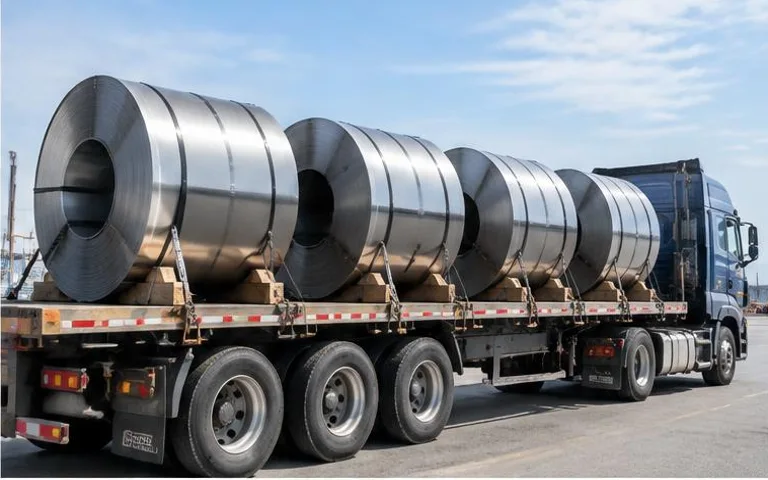
Physical integrity checklist
Compare containerization and other shipping options only after validating weight and handling limits. Upon arrival, trace any incident to the specific lot and preserve evidence for technical analysis and potential claims. Procurement should be approved based on expected industrial yield and net cost, not merely on the nominal volume of steel the supplier promises to load on board.
Ocean freight and inland handling of coils demand specific precautions to prevent cargo loss. Coils with damaged edges jam automatic uncoilers and break forming dies. Similarly, internal moisture condensation trapped under plastic wrapping leads to localized oxidation, rendering entire sections of the coil unusable.
To ensure that material arrives fit for use, adopt the following operational criteria:
Transform the quote into a financial decision
Compare suppliers based on landed cost into usable inventory, not just ex-factory price. Factor in merchandise, origin haulage, freight, insurance, actual applicable duties and taxes, terminal charges, customs clearance, domestic delivery, and financing costs. Separate firm quotes from estimates. A quote with fewer line items does not necessarily cover more services; request inclusions, exclusions, and responsibilities in writing.
Work with three scenarios: operation as planned, clearance delays, and partial lot rejection. Do not assign probabilities without empirical evidence. Calculate the impact on cash flow, inventory availability, and margin, including the cost of failing to fulfill customer orders. The chosen alternative must remain viable under adverse conditions; a contingency buffer is neither a guarantee of savings nor a contractual ceiling on expenses.
A common mistake made by procurement leadership is comparing a prompt-delivery domestic quote with an overseas FOB quote without equalizing payment terms and detention/storage costs. Working capital tied up during ocean transit, along with daily container demurrage or warehouse detention fees, can quickly wipe out the initial price advantage of imported steel.
Financial decision-making must weigh the following factors:
- Total delivered plant cost: the precise sum of all logistics, tax, and financing costs through final offloading at the manufacturing site.
- Sourcing partnerships: collaborating with over 10 partner trading companies to evaluate supply options across continents without over-relying on a single steelmaking hub.
- Service levels and security of supply: weighing spot purchases against scheduled supply contracts with staggered deliveries.
- Foreign exchange exposure: implementing currency hedges or financial protection tools to guarantee final disbursements align with the approved plant budget.
Governance to authorize and learn
Formally record who approves specifications, regulatory classification, payment, and dispatch. Verify bank beneficiaries via an independent channel, and reconcile invoice, packing list, and technical descriptions prior to cargo pickup. Reference the Receita Federal Customs Manual to guide clearance and check Siscomex for the operation's administrative status. Never assume that an operational workflow used previously remains valid, or that every product will follow the same declaration.
Following receipt, compare budgeted versus actual costs, record damage and rejections, and investigate the root cause of every deviation. Update subsequent purchase orders using this evidence. An advisory firm's role is to coordinate data and contracted service providers; it does not entail owning terminals, warehouses, freight carriers, or proprietary logistics infrastructure.
The operational maturity of an importing manufacturer depends on a continuous internal audit cycle:
- Prior alignment: before issuing the purchase order, engineering, procurement, and tax departments jointly sign off on the technical specifications and chosen tariff code (NCM).
- Pre-shipment validation: independent visual and dimensional inspection at the mill yard before cargo enters the port berthing area.
- Document audit: rigorous cross-check between quality certificates and physical labels affixed to the coils during container unstuffing or offloading in Brazil.
- Technical feedback loop: tracking line stoppages caused by steel defects to feed supplier scorecards and refine tolerances in future contracts.
Frequently asked questions
What is the difference between country of origin and country of provenance when importing coils? The country of origin is where the steel was actually melted and rolled. The country of provenance (or shipment) is where the merchandise was located when acquired for export to Brazil, which may simply be a transit point or a trading firm's warehouse. Trade defense duties and tariff treatments are grounded in the actual origin of the product, not the invoicing country.
How can one prevent imported coils from causing stamping defects on the assembly line? Safeguards lie in contractually tying the supply to strict technical standards and rejecting loose "commercial quality" specifications. Demand guaranteed minimum and maximum mechanical properties, material aging limits for low-carbon steels, and mandatory advance delivery of the mill test certificate with the heat analysis.
Which logistics risks drive up flat steel import costs the most? The primary budget overruns stem from container demurrage due to customs delays, overweight surcharges at terminals lacking heavy-lift cranes, and physical damage caused by substandard packaging. Utilizing warehousing partners in the Santos area equipped with specialized facilities, alongside multimodal distribution partners, minimizes mechanical damage and avoids ancillary domestic handling fees.
What is the role of a specialized advisory firm in managing these purchases? A strategic consultancy structures the process, aligns engineering requirements with customs regulations, and coordinates service providers—such as more than 10 partner trading companies and customs broker partners with over 25 years of experience. This governance role does not replace the importing company's legal accountability, nor does it imply ownership of warehouses or a dedicated transport fleet.
Sources and scope of analysis
Public sources accessed on 10/31/2026. Informational guidance pages do not substitute for official statutory acts and transaction-specific inquiries. The historical references identified below are not presented as current events.
Steel: establish scope under a specific act, not just an NCM code
The MDIC official measures-in-force index is a discovery tool, not sufficient evidence that any coil is covered. As a concrete example, Gecex Resolution 758/2025 concerns non-grain-oriented magnetic flat-rolled silicon steel originating in Germany, China, South Korea and Chinese Taipei. It mentions NCM codes 7225.19.00 and 7226.19.00; this does not make every product under those codes subject to the measure.
Read the product definition and annexes against composition, magnetic properties, coating, dimensions and any exclusions in the technical specification. Do not transfer the conclusion to grain-oriented steel, galvanised coils or another product simply because it is supplied in rolls. Record a reasoned SKU-level conclusion and obtain clarification where commercial descriptions are insufficient.
The official case page lists subsequent instruments, including Gecex Resolution 857/2026 concerning public interest. The 2025 text alone therefore cannot close the operational assessment. Check amendments, review, suspension and status on the relevant date; a page update timestamp does not replace reading the legislation.
Identify actual origin, manufacturer and exporter. Shipping country and an intermediary seller do not establish those facts. Reconcile certificates, technical specifications, invoice and packing list, retaining supply-chain evidence. Check the specific act and modifications, including company-specific provisions where relevant.
This section states no duty rates, amounts or applicability to a hypothetical coil. Before contracting, retain sources, consultation date, document version and the responsible reviewer’s decision. To organise the scope dossier, contact us.