

Importing yarn: technical sheets, NCM and attributes without guessing
Organize composition, process, Dtex, twist and tenacity evidence to describe yarn and validate import-process fields.
A yarn sheet starts where the sales name stops
“Knitting yarn,” “premium polyester” and a catalogue reference do not, by themselves, explain what is being imported. Identifying yarn requires its raw material, composition by mass, production process, construction, processing and relevant technical quantities. Industrial use and brand provide context, but cannot replace the characteristics that distinguish products within the nomenclature.
This guide organizes the collection of those facts and their use in descriptions, NCM classification and attributes. It complements the textile batch-approval hub without repeating purchasing criteria. If the imported product is already fabric, use the fabric-description guide, which addresses a different set of fields.

What ADE 22 actually requires for yarn
ADE Coana No. 22 of 23 September 2005 is marked in force in Receita's official database. Article 1 covers imported or exported yarns and fabrics classified in NCM Chapters 50–60. Description applies to the item within each addition, not merely to the purchase order or commercial family. Its correct designation is Ato Declaratório Executivo, not Portaria. Official act.
For yarn, the annex requests the nature of the raw material and composition: “Especificar a composição percentual do fio, mencionando a % em peso, de cada um dos seus constituintes.” This means stating each constituent's percentage by weight. It distinguishes natural, artificial and synthetic fibers, with examples of each. Calling the material “chemical” does not remove the need to identify the actual fiber.
It also distinguishes staple-fiber yarn—carded, including ring or open-end, combed or other—from continuous monofilament or multifilament yarn, with categories including partially oriented, textured, smooth, elastomeric and high-tenacity yarn. Other fields cover single, folded or cabled construction; unprocessed, dyed, bleached, fancy or other processing; and bobbin, cone, cops or other packaging. Official full text.
One documentary caveat remains: the official text numbers the commencement provision Article 5, while a secondary reproduction uses Article 3. Its express thirty-days-after-publication rule conflicts with commencement metadata. Without the original gazette scan, we do not correct the numbering by inference. The database's current in-force status is separate from that historical inconsistency.
Dtex, twist and tenacity: no unit shortcuts
The additional fields expressly read “Título (em DTex),” “Tenacidade (se aplicável) (em cN/Tex)” and “Número de torções (voltas/metro).” They require count in Dtex, tenacity where applicable in cN/Tex, and turns per meter. The applicability qualification attaches to tenacity; it does not make the other fields optional. Report the documented situation, including confirmed absence of twist, rather than supplying a typical value.
Dtex expresses grams per 10,000 meters of yarn. Establish whether the count refers to the finished yarn or an individual component. For folded or cabled yarn, the number of constituent yarns and their counts must not be confused with the resulting count. Do not automatically add or convert numbers when the manufacturer's notation is ambiguous.
Turns per meter are not the number of filaments. An S or Z twist direction, when supplied, does not replace the number of turns. Tenacity expresses force relative to linear density: absolute breaking force is not directly the requested cN/Tex value. Request units, sample identification and technical support when uncertain. A “high tenacity” sales claim requires verification, not automatic translation into a customs category.
This guide does not repeat the problematic English cotton-count Ne definition in the official glossary or offer calculations based on it. Preserve the supplier's original unit and obtain technically confirmed Dtex information. An official source is not a reason to propagate a dimensionally questionable conversion.
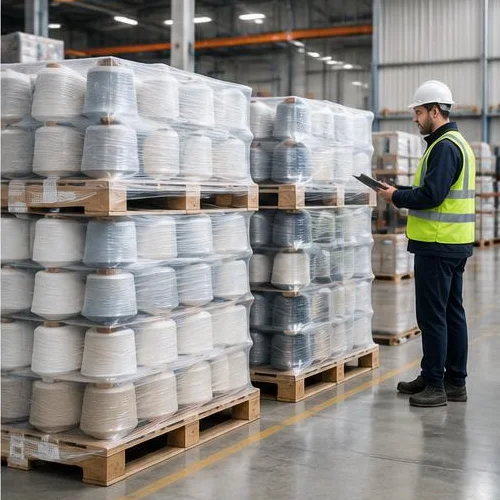
Manufacturer questionnaire and supporting evidence
Create a sheet for each reference and technical variant. Request composition totaling 100% by mass; staple fiber or continuous filament; mono- or multifilament; relevant process; single or folded construction; processing; packaging; Dtex count; turns per meter; and tenacity where applicable. Add manufacturer identity, revision and batch linkage for traceability, distinguishing those internal controls from the ADE's express fields.
Seek clarification whenever a document combines incompatible characteristics or fails to explain a number's basis. “100% polyester” does not establish whether the yarn consists of staple fibers or filaments. A cone photograph cannot demonstrate texturing. A certificate without a link to the article does not automatically close the evidence gap.
Buyers should not complete answers from a competitor's sheet or blindly repeat the previous batch. If the factory cannot answer, record the unresolved issue and obtain suitable technical support or testing. Tests and certificates are not presented here as universal obligations or guarantees of customs release; they are possible ways of establishing relevant facts.
NCM, DI NVE and Duimp attributes
The NCM decision comes before selecting fields linked to that code. Consider classification rules and legal notes. Composition, process and construction may be decisive, but no simplified “main fiber” rule replaces the complete analysis. The overseas supplier's code requires validation against the Brazilian nomenclature.
For DI, check NVE where the product falls within the applicable annex. The verified current reference is Portaria Coana No. 159 of 5 August 2024, published on 16 August. Article 4 repeals 81/2022, effective 14 November 2024 under Article 5's commencement rule. This complementary-data regime does not replace the ADE description or repeal that act merely because both concern product information. Official Portaria.
For Duimp, attributes are structured by NCM in the Catalogue, Duimp and LPCO modules. Siscomex explains that they will replace NVE; it does not instruct operators to copy old codes. Check conditions, units and permitted answers in production, which may differ from training. 3.
The official Catalogue FAQ, October 2024 reference, explains registration and management while warning that the system evolves. Preserve versions and assess technical changes before reusing a record. Also consult the Duimp guide. A screen without errors is not evidence that the underlying facts are correct.
Hypothetical example: building the description
Consider fictional article Y-310: 100% polyester by mass, continuous multifilament, textured, single yarn, unprocessed, supplied on cones, finished count 167 Dtex and 80 turns per meter. Assume the operation's technical assessment considers tenacity applicable and the supporting document confirms 30 cN/Tex.
One possible description is: “Polyester yarn, 100% by mass, article Y-310; continuous multifilament; textured; single; unprocessed; supplied on cones; finished count 167 Dtex; twist 80 turns/meter; tenacity 30 cN/Tex.” All data are hypothetical and demonstrate organization only. They do not indicate an NCM or establish legally defined high-tenacity status.
If the supplier provides only commercial notation, drafting must await clarification. This illustration does not authorize using similar numbers in a real sheet. The team must still validate classification and the attributes actually associated with the product.
Documentary release checklist
Frequently asked questions and next steps
Can “weaving yarn” be the description? Only as additional context. Intended use does not supply composition, process or other required information.
Is tenacity always mandatory? The annex says “where applicable.” That decision needs technical support and must not become a shortcut for concealing an unknown value.
Does the label settle discrepancies? No. Commercial labeling and customs description serve different purposes. Investigate the underlying technical facts and reconcile the documents.
Must everything be registered again for every batch? Do not assume so. Assess product identity and version rules without reusing outdated information.
To organize review between supplier, importer and customs representatives, contact us. Refusing to guess is an essential part of a defensible operation.