

Ocean or air: compare total cost and working-capital impact
Choose ocean or air by assessing inventory, stockout exposure, insurance and delivery. Build total-cost scenarios instead of comparing freight rates alone.
A Choice of Capital and Service
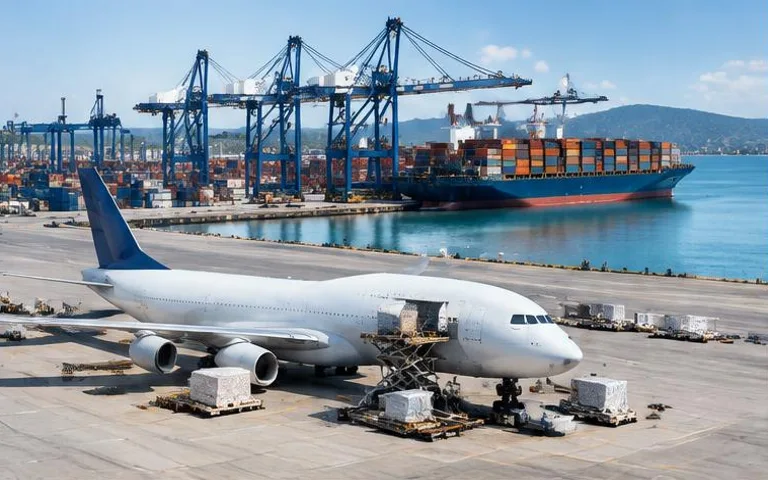
Comparing ocean and air freight solely by the international freight rate means evaluating only a fraction of the operation. Ocean freight typically accommodates significant volumes and regular replenishments at a lower direct transportation expense. On the other hand, air freight drastically reduces transit days, protecting production lines against unplanned downtime or securing revenue during commercially critical windows. The right executive decision does not merely seek the lowest freight rate per kilogram or cubic meter. The real objective is to identify the alternative that ensures the market's required service level with the lowest possible financial exposure.
To conduct a fair comparison, leadership must rigorously align the starting and ending points of each proposal. An air quote delivered only to the international airport cannot be directly compared against an ocean quote delivered directly to the factory warehouse. Factors such as payment currency, exchange rates, batch volume, International Commercial Terms (Incoterms), and proposal validity periods must be fully aligned.
In this analysis, the operational structure directly influences the outcome. Operations supported by specialized partners—such as a network of more than ten partner trading companies, partner customs brokers with over twenty-five years of experience, partner warehousing facilities in the Santos region, and partner multimodal distribution networks—are able to map true end-to-end costs. This integrated view prevents savings achieved on the international leg from being erased by unexpected destination expenses or clearance bottlenecks.
Build an Auditable Calculation
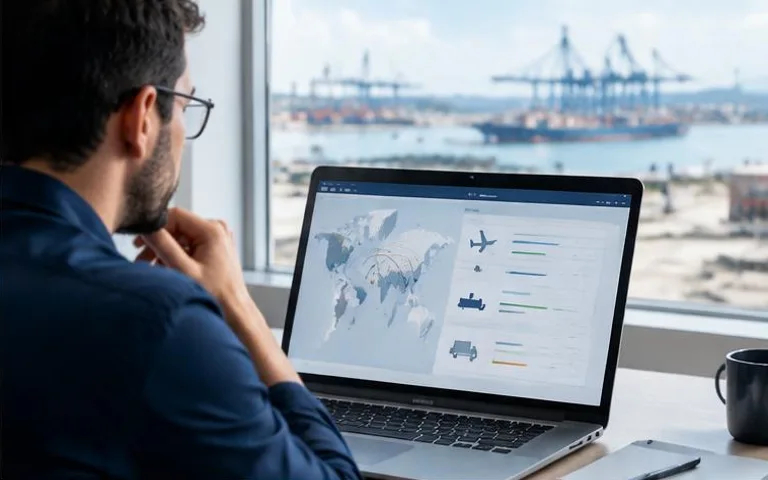
A sound decision requires an analytical total landed cost spreadsheet that can be audited by any department within the company. The landed cost must combine the ex-factory product value, local origin charges in the exporting country, international freight, insurance premiums, port or airport fees in Brazil, customs clearance fees, applicable taxes and duties, and inland trucking through final delivery.
For the calculation to be accurate, the technical team should follow structured consolidation steps:
- Origin expense assessment: Consolidate pickup fees, inland transport, export clearance, and documentation issuance in the country of origin.
- Precise definition of international freight and surcharges: For air freight, verify the application of the gross weight versus volumetric weight ratio, along with security and fuel surcharges. For ocean freight, separate the base ocean rate from operational surcharges and terminal handling charges (THC).
- Customs and tax mapping: Evaluate the tax assessment base for federal and state taxes levied on the operation. Differentiate initial cash outlay from amounts that can be recovered later via tax credits, always validated in advance by the tax department.
- Destination and clearance costs: Account for primary storage, yard handling, physical inspection fees, and services performed by partner customs brokers experienced in local regulations.
- Warehousing and distribution: If cargo arrives by sea, evaluate utilizing partner warehousing facilities in logistics hubs such as Santos, integrated with multimodal distribution operators through the final destination.
- Calculation of tied-up working capital: Measure the financial impact of the days capital remains tied up throughout the entire cycle of procurement, international transit, customs clearance, and inventory holding.
Common mistakes often undermine this analysis. One of the most frequent is applying a generic average cost of capital rate without consulting the treasury department. Every company has its own liquidity profile and specific borrowing costs. The time value of money should reflect internal financial realities rather than theoretical market benchmarks.
Another classic pitfall involves assumptions around commercial losses. Assuming that every day of delay results in an immediate, total loss of sales skews the comparison in favor of air freight. Conversely, ignoring the risk of an assembly line shutdown that carries severe contractual penalties skews the calculation in favor of ocean freight. All opportunity cost assumptions require joint validation across sales, procurement, and production.
Mode-specific costs must also appear as detailed budget line items. In ocean shipping, vigilant management of container free time and demurrage/detention costs avoids cash flow surprises. In air shipping, understanding chargeable weight break points prevents minor packaging adjustments from triggering substantial freight rate increases.
Test Scenarios, Not a Promise
Planning imports solely based on average transit times quoted by carriers exposes cash flow to risk. Managers must stress-test distinct scenarios before authorizing purchase orders:
- Base scenario: Reflects the typical operational flow of the route, with standard origin handling times, normal transit, and routine destination clearance.
- Delay and bottleneck scenario: Simulates extended hold periods resulting from adverse weather, vessel blank sailings or port rescheduling, terminal congestion, or slower customs inspection channels.
- Demand fluctuation scenario: Models inventory behavior if sales exceed forecasts during transit or experience an abrupt downturn.
For each scenario, leadership must cross-reference three critical variables: estimated customer delivery date, safety stock requirements, and the volume of cash committed throughout the cycle.
Evaluating these variables yields practical decision criteria:
- Value-to-weight ratio: High-value goods with low weight generally absorb air freight costs without significantly impairing unit margins.
- Product lifecycle: Items subject to rapid technical obsolescence or perishability require fast time-to-market, favoring the speed of air transport.
- Ocean supply chain reliability: When demand is steady and predictable, ocean replenishment with scheduled, frequent sailings offers superior economic sustainability—especially when backed by established port logistics partners.
- Stockout severity: The financial or contractual penalty associated with supply shortages is the decisive factor that justifies the air freight premium.
Often, the optimal logistics solution lies in a hybrid sourcing model. A company can split the purchase order: dispatching an initial small batch via air to cover urgent demand and prevent stockouts, while shipping the bulk volume by sea. This approach balances customer service levels and protects working capital liquidity, provided that duplicated fixed customs clearance and documentation fees are accounted for in the cost model.
Decision Committee Checklist
Before finalizing international transport contracts, the executive procurement and logistics committee should verify the following:
Following the completion of the import process and the physical delivery of goods, the team must compare budgeted costs against actual spend. Significant variances should be categorized into operational breakdowns, tax adjustments, or flawed planning assumptions. This feedback loop informs future committee decisions and prevents reactionary switching between modes without addressing root causes.
Frequently Asked Questions
Does the lowest freight rate yield the lowest total cost?
Not necessarily. Lower international freight rates can easily be offset by steep destination storage fees, the cost of working capital tied up during long transits, or commercial losses resulting from stockouts.
Can I apply the same decision across the entire product catalog?
This practice should be avoided. Products with differing margins, cargo densities, demand variability, and contractual liabilities require segmented logistics strategies tailored by product family.
When is it worth adopting a hybrid ocean-air model?
A hybrid approach is recommended when there is an urgent need to maintain customer fulfillment or prevent a factory shutdown, while the remaining volume sails by sea to lower the average unit cost of the shipment.
Do official customs guidelines indicate the ideal rate?
No. Customs regulations and manuals detail the statutory procedures and cargo enforcement controls applied by regulatory authorities for each mode. It is up to the company to negotiate commercial terms and operational conditions with its service providers.
Sources and Editorial Reference
Editorial reference: October 31, 2026. Operational conditions and regulations must be confirmed for each operation.