

Auto parts: buy compatibility and supply continuity
Organize auto-parts imports around compatibility, criticality and quality evidence.
Strategic analysis by Jiuann Teng — editorial baseline: October 31, 2026. This is not news reporting nor confirmation of any regulatory change on this date. The decisions below depend on the specific product, intended purpose, and actual operational execution. Reconfirm the applicable regulatory provisions prior to contracting and prior to shipment.
In the foreign trade of automotive components, the lowest ex-factory unit price rarely translates into the lowest final cost. For executives managing industrial supply chains or aftermarket replacement networks, profitability hinges on two critical variables: exact technical compatibility during assembly and uninterrupted supply continuity. When a component fails in application or is delayed in customs, the financial fallout quickly outstrips any initial commercial discount.
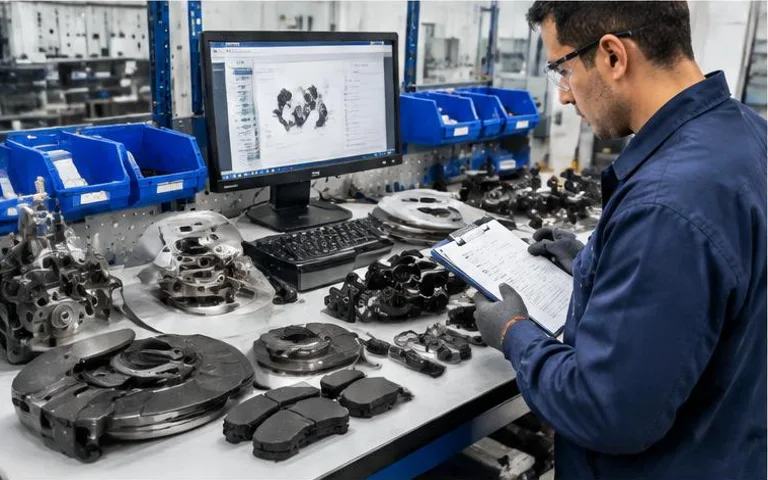
Catalog Part Numbers Do Not Guarantee Application Fit
A similar part number can easily conceal differences in geometry, metallurgy, electrical pinouts, or calibration. Record the exact part number, revision levels, compatible vehicles or subassemblies, and operational limits. Do not accept the designation "OEM equivalent" without verifiable technical proof. Compatibility must be established through engineering documentation and, where appropriate, testing protocols established by engineering or the designated technical authority.
Common errors at this stage include blindly trusting generic third-party cross-reference tables and overlooking batch-to-batch variations from the manufacturer of origin. Subtle modifications in heat treatments, metal alloys, dimensional tolerances, or polymer formulations can render a component unusable under real-world operating conditions, causing premature wear or critical assembly failures.
Segregate safety components, line-stoppage items, and intermittent-demand parts. While this commercial classification guides inventory planning and incoming inspections, it does not replace regulatory categorization. Review the regulatory scope of Inmetro for each component type and verify the administrative import treatment governing the transaction. Do not assume that all auto parts require compulsory certification, nor that a single family certificate covers every product offered by a supplier.
Structured technical validation should follow a clear sequence of steps before finalizing any commercial purchase order:
- Cross-reference the original technical drawing against the manufacturing supplier's technical specification.
- Map physical interfaces, mounting points, electrical circuits, and operational tolerances.
- Obtain test samples for dimensional inspection and functional bench or prototype testing.
- Formalize a technical approval document signed by the company's responsible engineering team.
Predictability Starts with the Bill of Materials
Maintain an approved parts list and enforce strict drawing revision controls. Contractually require advance notification of any change in manufacturing facility, raw materials, or production processes before manufacturing begins. For critical items, establish initial production sample sign-offs, clear measurement criteria, and lot-level traceability. Inspection reports must explicitly state what was measured and the pass/fail criteria applied; generic statements of quality do not solve application requirements.
Supply chain stability depends on a logistics architecture designed to neutralize bottlenecks at origin and destination. In complex operations, executives rely on collaborative networks of strategic partners. This operational ecosystem typically brings together more than 10 partner trading companies for freight consolidation, partner customs brokers with over 25 years of technical expertise in customs clearance, partner warehouses in the Santos logistics hub, and partner multimodal distribution networks throughout the national territory. Seamless integration among these partners prevents cargo from stalling at intermediate handoffs.
Plan replenishment around actual consumption rates and the cost of a stockout. An inexpensive component may justify carrying buffer stock if its absence halts the assembly of a high-value system. Weigh emergency expedited freight against proactive safety inventory without defaulting to air freight as an automatic reflex. Define who holds approval authority for emergency freight and what data validates the need. Consolidation programs must respect individual cargo readiness dates and never conceal one supplier's delays behind an aggregated delivery projection.
Essential criteria for selecting transport modes and setting operational buffer levels:
- Downtime severity: If a missing part shuts down an assembly line, the cost of air freight is justified; if it replenishes commercial turnover stock, consolidated ocean freight is the correct route.
- Shelf life and obsolescence: Components subject to frequent engineering revisions require smaller, more frequent purchasing cycles to prevent obsolete inventory write-offs.
- Origin manufacturing lead time: Suppliers with long production cycles demand orders triggered by minimum inventory thresholds rather than ad-hoc production runs.

Checklist Prior to Recurring Purchases
Approve recurring production orders only after thoroughly reviewing the performance of the initial lot. When an engineering revision occurs, do not automatically mix legacy and new parts in the warehouse. Maintain strict traceability linking product, application, and end customer to enable rapid containment should issues arise. Supply continuity depends on this discipline just as much as on contracted transit times.
Turn Quotations into Financial Decisions
Evaluate suppliers based on the total landed cost to usable inventory, not just the ex-factory quotation. Factor in the product price, origin cartage, international freight, cargo insurance, applicable customs duties and taxes, terminal handling charges (THC), customs brokerage, domestic delivery, and inventory financing costs. Distinguish firm, committed quotes from provisional estimates. A proposal with fewer line items does not necessarily cover more scope; demand all inclusions, exclusions, and operational boundaries in writing.
The opportunity cost of tied-up working capital and container demurrage exposure must be built into the financial model. Many companies stumble when evaluating supplier proposals because they review Incoterms superficially, overlooking local port surcharges, bonded warehouse storage fees, and dedicated transport expenses to the receiving plant.
Model three financial scenarios: operation as planned, clearance delays, and partial lot rejection. Do not assign arbitrary probabilities without operational evidence. Calculate the direct impact on cash flow, parts availability, and operating margins, including the commercial cost of failing to fulfill customer commitments. The selected alternative must remain financially viable under adverse conditions; a contingency reserve provides neither guaranteed cost savings nor a contractual ceiling on expenses.
When structuring a decision matrix between potential suppliers, use objective criteria:
- Total landed cost: Sum of all expenses incurred through delivery into the internal warehouse.
- Delivery reliability: Historical track record of meeting factory cargo readiness dates.
- Minimum order quantity (MOQ) flexibility: Feasibility of procuring smaller batches without punitive unit-price increases.
- Post-sale technical support: Formal willingness to deliver root-cause analysis (8D) reports in the event of non-conformities at destination.
Governance to Authorize and Learn
Formally define who holds authority to sign off on technical specifications, regulatory classifications, payment disbursements, and cargo release. Verify banking beneficiary details through independent channels, and cross-reference the commercial invoice, packing list, and technical descriptions prior to dispatch. Use Receita Federal’s Customs Clearance Manual for clearance guidance and Siscomex to consult the administrative treatment applicable to the operation. Never assume that a clearance channel used previously will remain available or that every product will process under identical declarations.
Segregation of duties ensures that commercial delivery pressures do not bypass legal obligations or technical engineering standards. Procurement teams must not possess unilateral authority to switch approved suppliers without formal approval from quality control and regulatory compliance personnel.
Following receipt, reconcile budgeted costs against actual landing costs, log transit damages and product rejections, and identify the root cause of every operational variance. Feed these findings directly into the next purchasing cycle. The advisory role is to coordinate information and contracted logistics providers; it does not imply owning terminals, warehouses, transport fleets, or proprietary infrastructure. Integration with specialized third-party warehousing, logistics, and customs partners must be managed through transparent contracts and clearly delineated liabilities.
Frequently Asked Questions
What is the difference between geometric compatibility and functional compatibility in an automotive component?
Geometric compatibility means solely that the component physically fits into the designated assembly space. Functional compatibility requires the component to withstand the system's thermal, mechanical, chemical, and electrical operating loads, performing within engineered tolerances without degrading adjacent assemblies or compromising overall vehicle safety.
How do you determine whether an imported part requires an import license or mandatory certification?
Verification must be conducted through Siscomex and the specific Inmetro regulations governing automotive components. The tariff classification code (NCM), combined with the technical nature of the component, its commercial application, and the target end-user market, determines whether a pre-shipment import license (LI) or mandatory conformity certification is legally required.
Why can buying at the lowest unit price increase the total landed cost?
Parts sourced solely based on the lowest factory price frequently present higher scrap and rework rates, documentation discrepancies that stall shipments at customs—triggering expensive storage and demurrage fees—and an increased risk of assembly line shutdowns. The true cost includes these operational losses, emergency logistics expenses, and downstream customer dissatisfaction.
How do small and medium-sized enterprises achieve logistics predictability without operating their own warehouses?
Companies achieve predictability through coordinated partnerships with specialized logistics providers. They utilize partner warehouse facilities near major ports, contracted dedicated haulers, and partner customs brokers, integrating the entire supply chain through rigorous contractual governance without tying up working capital in heavy physical infrastructure.
Sources and Scope of Analysis
Public sources consulted on October 31, 2026. Guidance resources do not supersede official regulatory statutes or case-specific administrative determinations. Historical references cited below are not presented as current events.
- 1 — Receita Federal — Import Customs Clearance Manual
- 2 — Siscomex — Administrative Treatment in Imports
- 3 — Inmetro — Component Conformity Assessment
- Referência editorial setorial / Sector editorial reference / 行业编辑参考:DC Logistics, 07/09/2026 — https://dclogisticsbrasil.com/importacao-de-autopecas-custos-prazos-e-estrategias-para-uma-operacao-mais-previsivel/ . Não é fonte de obrigação legal / Not a legal authority / 非法律依据。