

Replacement automotive parts: certify the component, not the catalogue
Assess components under Ordinance 145/2022 and connect certificates, families, factories and shipments without confusing fitment with compliance.
Ask which component and which intended market
A replacement-parts catalogue may combine items governed by different programmes and items outside a particular regulation. “Automotive part” does not define a universal certification requirement. Before negotiating quantities, describe the component’s function, intended road vehicle, technology and application. This article complements the automotive parts hub: the decision here concerns regulatory scope, not another general discussion of availability, sourcing continuity or fitment management.
Inmetro Ordinance 145/2022 consolidates requirements for specified components intended for the replacement market. Its official register identifies the instrument and related legislation; also consult the text and relevant annexes before deciding applicability. A commercial list cannot replace the scope provision. Neither a cross-reference to an original part nor a shared NCM tariff code proves that two versions receive identical regulatory treatment. Record the evidence supporting the actual item being purchased. 1
Turn the scope provision into a decision for each SKU
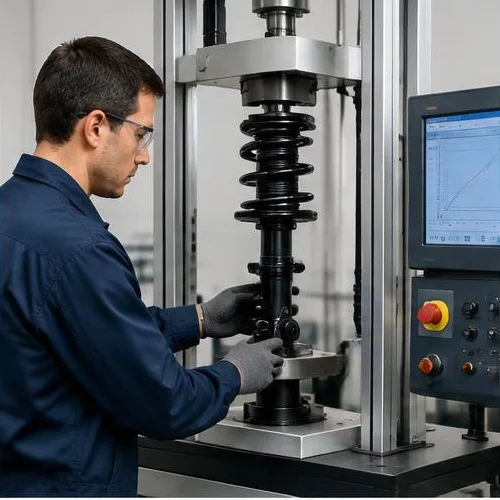
Article 3 of Ordinance 145/2022 defines specified replacement components for motorised road vehicles, including, for example, suspension shock absorbers, electric fuel pumps for Otto-cycle engines and horns. These examples are neither a complete list nor permission to include every pump or shock absorber. Compare function, technology, intended market and exclusions with the provision and the technical annex for the actual component. The relevant definition matters more than the heading printed in a supplier’s catalogue. 2
Prepare a short decision note containing the description, relevant characteristics, manufacturer’s document, legal basis and conclusion: covered, outside this programme, or awaiting information. “Outside this programme” does not mean free from every regulation. Tyres, for example, require their own analysis and should not be absorbed into a generic reading of this ordinance. If the supplier cannot identify application or technology, leave the decision pending rather than filling the gap with a similar photograph or another buyer’s certificate.
Fitment does not demonstrate regulatory conformity
An application table may show that dimensions, connectors and interfaces match a vehicle. It does not demonstrate compliance with the Brazilian conformity programme. Similarly, a certificate does not automatically establish that the part fits the customer’s vehicle. Maintain two approvals: mechanical or electrical application, reviewed by the technical specialist, and regulatory conformity, documented for the actual family and model. Neither approval should silently stand in for the other during purchasing or receiving.
Request the factory code, brand, drawings, relevant materials, manufacturing site and application references. Establish whether the offered item is the one identified in the certificate schedules. Avoid descriptions such as “universal” when they conceal technical variants. For a fuel pump, engine type is important when comparing the product with scope; other components will have different decisive parameters. Do not transplant one family’s criteria to another merely to accelerate commercial registration or to simplify the supplier’s paperwork.

Certificate, family and factory must align
For covered components, confirm the certification mechanism and applicable procedure with a Product Certification Body, or OCP, accredited for the scope. Obtain the full certificate, schedules and information required to verify its status. Check the holder, manufacturer, production site, brand and family/model identification. A PDF displaying a logo, or a number sent in a message, does not demonstrate authenticity, coverage and continuing certification status for the goods in your order.
Ask explicitly whether the ordered codes are covered and which grouping rule supports the answer. Do not conclude that every product from a factory is certified because one family appears in a document. Also check registration requirements and procedures relevant to the component and transaction, without treating certification, registration and import consent as one document. The official compulsory-programme index helps locate programmes, but older references in an index cannot replace the updated regulation and its annexes. 3
Markings and import controls need their own reconciliation
Check conformity identification, markings and instructions required for the particular component. Assess location and presentation against relevant requirements rather than inventing one marking format for every part. Compare approved artwork with photographs of packed production. Physical identification should connect the goods to the evidence without borrowing a mark or number from another family. Applying a label in a warehouse does not automatically repair missing certification or certification that does not cover the product.
Before shipment, check administrative treatment using the actual NCM, attributes and operation, taking account of the available declaration workflow. The licensing and LPCO guide organises this check. Do not claim that certification eliminates every import approval or that every part needs the same LPCO. Describe components in invoices and packing lists so codes, quantities and packages can be reconciled; consult the documents guide. Commercial documents identify the shipment, but cannot enlarge the scope of a certificate.
Checklist for order release and change control
Purchasing should attach the approved technical version to the order. Quality should define receiving checks and additional contractual criteria without presenting them as universal legal duties. The import team should retain administrative-treatment checks and process decisions. If anything changes after approval, reopen the assessment before dispatch. Moving production to another plant or changing an internal component may require OCP action; the team should not infer equivalence solely because the commercial product code remains unchanged.
Hypothetical example: a pump with incomplete identity
A distributor receives an offer for an electric fuel pump accompanied by a certificate for one supplier family. The seller describes its application only as “automotive”, without identifying engine type. The team requests specifications, a drawing and schedules, verifies the Otto-cycle application and compares the actual purchase code with covered models. Until that connection is demonstrated, shipment is not approved merely because the item resembles the certified product in a photograph.
The supplier then discloses production at another site. The distributor requests documentary confirmation and OCP assessment of coverage and any necessary action, while also checking markings and commercial documents. This example does not assume that every change invalidates a certificate or that every pump falls within scope. It illustrates a defensible sequence: identify the product, check applicability, establish coverage and only then authorise execution. Fitment validation for customers’ vehicles remains an independent technical task throughout the process.
FAQ and technical handover
Does every automotive part require Inmetro certification? There is no single conclusion for an entire catalogue. Check the programme corresponding to the component and intended market.
Is an overseas certificate sufficient? Do not presume equivalence. Compliance with the Brazilian programme depends on its requirements and the relevant assessment.
Does one NCM guarantee one certification family? No. Customs classification and certification grouping serve different purposes.
Can I import using another company’s certificate? Do not assume that possessing a PDF authorises your operation. Confirm the holder, coverage, supply relationship and applicable procedures with those responsible.
Does the conformity mark guarantee fitment? No. Application to the vehicle still needs its own technical validation.
Send product codes, applications, factory details, certificates and schedules through our contact page. The expected output is a component-specific list of decisions and outstanding issues, not a promise to certify an entire catalogue with one document.